“You are deliberate, strategic and think in an ecosystem way. Your ability to connect dots is phenomenal.”

LorraineCEO, Pngme
You have technology, funding, product and marketing. Yet growth stalls, agents churn, liquidity fails. The hidden economic constraint in your distribution system is holding everything back.
No courses. No hype. No generic frameworks.
Trusted by operators, platforms & founders across Africa
“You are deliberate, strategic and think in an ecosystem way. Your ability to connect dots is phenomenal.”
Most networks don't leak because of bad execution. They leak because of an invisible constraint in the economics, incentives, or trust. This is the same system I use in advisory and entrepreneur-in-residence work with fintechs, banks, and platforms across Africa.
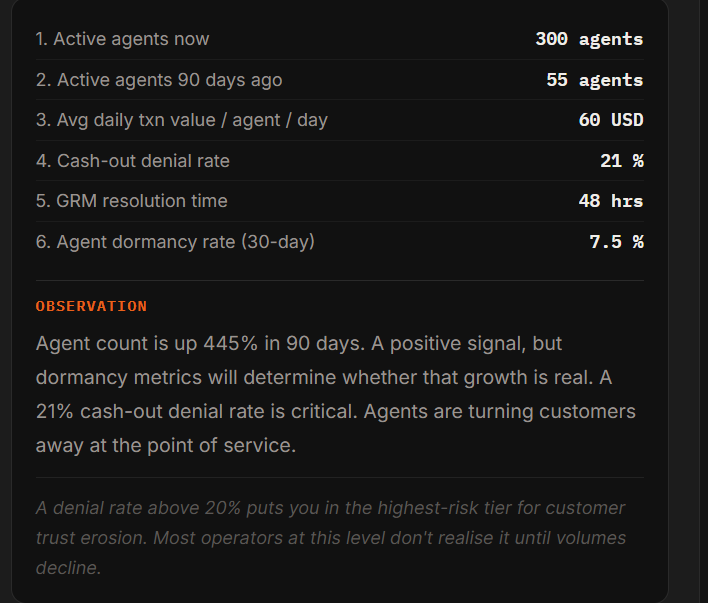
A structured review across all six lifecycle stages: onboarding, training, demand, liquidity, risk, dormancy, to surface the single economic constraint holding your network back, and the weakest stage to attack first.
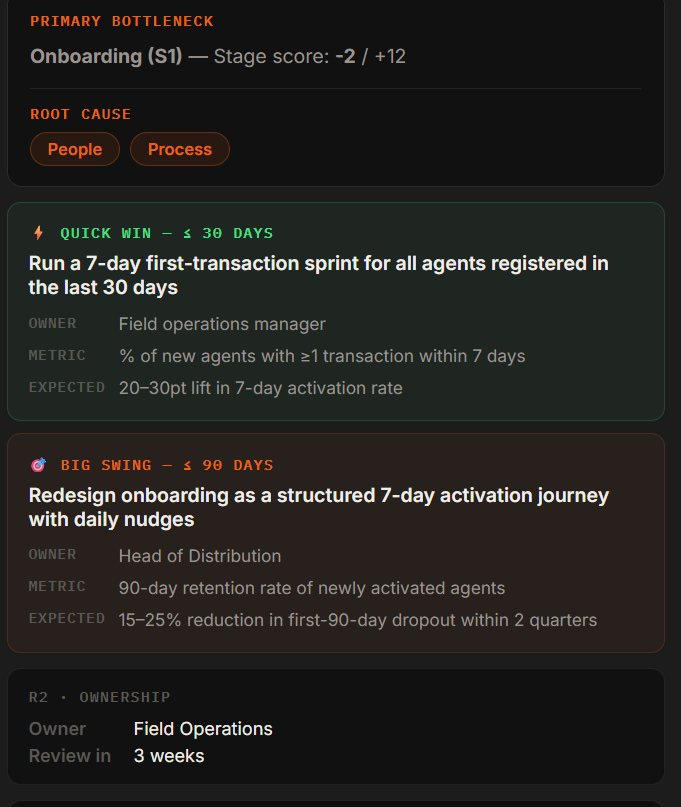
A 30-day quick fix and a 90-day structural move, each with an owner, metrics, and expected results. A ready-to-share brief built for your team, board, and partners, not a 50-page report.
Weekly working sessions with your ops and commercial teams to implement the fix: agent economics, liquidity design, commission structures, and the business-model patterns that fit your market.
Billed monthly, run in 90-day cycles. Same rate whether it's your first cycle or your fourth.
24 scored questions across all 6 AAARR lifecycle stages. You get a full network health scan, your weakest stage pinpointed, and the complete report in your inbox. Takes 8–12 minutes.
Run the diagnostic →Full archive, webinar, 20+ business-model patterns (postal-led, agri-led, MNO-led, rider-led, POS-led…), plus the tools & templates I use in real operator work.
Subscribe →One focused hour on your hardest agent-network problem. Come with data, leave with a decision. Ideal pressure-test before committing to a sprint.
Book a Power-Hour →Diagnose, fix, and scale with me embedded alongside your team, working directly with the CEO. Runs in 90-day cycles: fix one constraint, then find the next.
Book an intro call →“Hugo designed and delivered a training session on agents for African central banks. He did an excellent job of sharing his expertise. The collaboration was very fruitful.”
“Excellent session, very informative and well structured: a great opportunity for dialogue with industry partners.”
“Hugo was a great help as we reviewed our approach to last-mile distribution and agency networks. He is very knowledgeable and I would definitely recommend his services.”
Building a healthier agent-network ecosystem takes more than one operator. When a sprint surfaces a need outside my scope, these are the best-in-market partners I plug in.
Business development for teams expanding to Africa, LatAm, the US, or Europe. My go-to when a sprint uncovers a market-entry or partnerships gap.
European impact-debt platform channelling retail investors into licensed African lenders and MFIs. When the constraint becomes working capital or float financing, this is where I send you.
Central-bank licensing for transformational business-model shifts, and mediation with regulators when it counts, sequencing fixes before fines or denial of service.
Book a call first: I'll help scope the fit and pass you a partner rate.
Keynotes, webinars, and masterclasses on agent-network economics, liquidity, and distribution in emerging markets, grounded in 15 years of operator work, from M-Pesa agent lifecycles to central-bank training programmes.
Early stage (€2,400/mo) covers pre-Series A fintechs and networks under ~1,000 agents. Growth & scale (€4,000/mo) covers anyone operating across multiple markets, holding a regulated licence, or running more than ~5,000 agents — fintechs, SaaS platforms, banks, MFIs and remittance operators. We confirm the tier on the intro call, no negotiation theatre.
Plan for one 60–90 minute working session per week with your ops/commercial leads, plus async access to data and field teams. The sprint succeeds based on how well your team knows your agents: I bring the system, you bring the ground truth.
Yes, it makes the intro call twice as useful. You'll arrive knowing your weakest lifecycle stage, and we spend the call on what to do about it rather than on discovery.
Sprints run remotely by default, with weekly live sessions. On-site field visits can be added for growth-tier engagements where the diagnostic points to field-level execution issues.
I run a maximum of three sprints in parallel: every engagement gets me, not a junior team. Depending on the pipeline, there's typically a 2–4 week wait before kick-off. If you have a network review or scaling push planned for later in the year, reach out early to reserve a slot.
Between days 76 and 90 we re-run the diagnostic, measure movement on the metrics we set in week two, and build the plan for the next cycle. Then I tell you whether I think a second cycle is worth your money — not every sprint should continue, and I'll say so. If it should, we carry on at the same rate, usually shifting from internal fixes to ecosystem and positioning work: partnerships, funding for agent float, licensing and regulator conversations. If it shouldn't, you can stay on the tools alone via the Agent Network OS, or we close out. You keep the roadmap either way.
Start with the free diagnostic or book a 15-minute intro. Either way, you leave with decision clarity, not a sales pitch.
Book a 15-min intro call